





 Scodix Foil (Matte Gold)

 Scodix Sense

 Scodix MLE (Uncoated)


A Raven for the Raptors
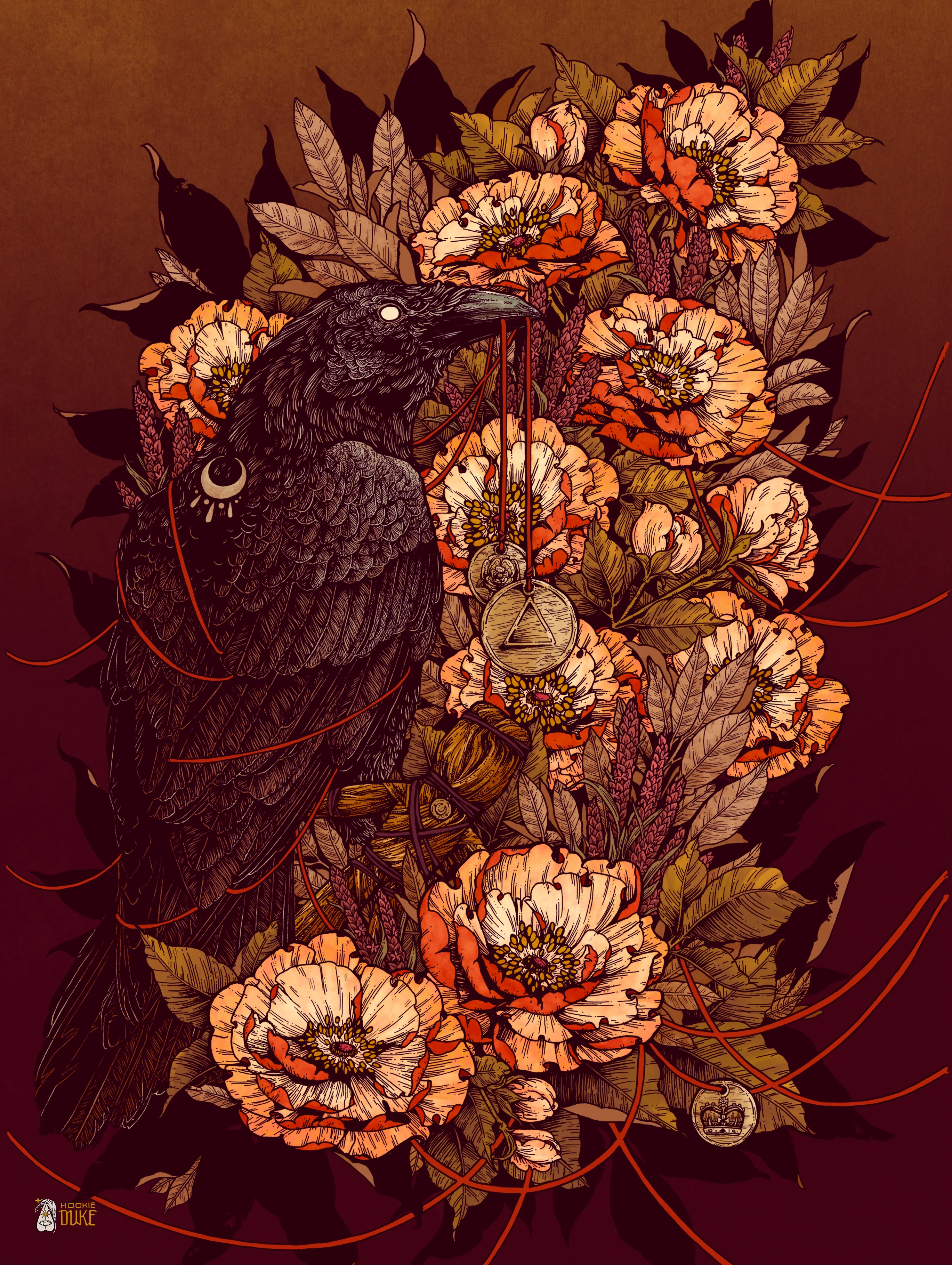
Corvus Corax began with April Lytle at Scodix, who wanted to show what Scodix digital enhancement could do for fine art. She had seen our FSEA Gold Leaf–winning The Kiss, and together we planned a limited edition that would combine HP Indigo printing, digital sleeking foil and Scodix embellishment. The finished prints would be donated to the Carolina Raptor Center in Huntersville, North Carolina, to support its conservation work.
A raptor center called for wild birds. Two artists contributed their work and files: Erica Williams, whose raven is shown here, and Jon Ching, whose barn owl crowned with monarch butterflies became Monarchy. Erica painted Corvus Corax in 2017 as the cover for Nicholas Bowling's novel Witch Born, and gave us the artwork when the project was proposed in 2024. We printed the edition in September 2025: 90 sheets, of which 50 went to the Raptor Center and 25 to Erica.
Erica paints digitally, and her file arrived with hundreds of Photoshop layers. Because every feather, petal, coin and thread sat on its own layer, April and I could select small details across the piece and give each one its own effect. We worked on separate copies of the file: I proofed sleeking foils, color profiles, metallic inks and papers for Erica's review, and April soft-proofed the Scodix work. Throughout, the aim was for the art to stay the star, with every metallic effect complementing the illustration rather than competing with it.
Choosing the Paper
We proofed on coated stocks first, but with the foils added they had too much shine for this artwork. A smooth uncoated sheet held the foil well but lacked the feel of a fine art print. So we chose Hahnemühle cold press art paper, knowing it was a gamble. No one had run it through Scodix, and its deep tooth is about the hardest surface there is for digital foil.
Color stayed simple. Of the profiles we tried, most pushed Erica's reds and earth tones too dark or too warm, so the piece prints in straight CMYK.
Foil That Holds on Cold Press
Digital sleeking foil bonds to toner, not to paper, and it needs a smooth, continuous toner surface to bond cleanly. The usual base is registration black, which is fine on a smooth uncoated sheet. On cold press, a thin toner layer follows the tooth, leaving peaks and wells, and the foil catches the peaks and skips the wells. The HP Indigo can lay down up to sixteen hits of ink to build a smoother surface, at some cost to registration and sheet stability. Proofing suggested twelve hits of white would do. In production they didn't, and the silver foil came out badly degraded.
Spot gloss foil as the bond coat
Spot gloss sleeking foil sticks to every ink and every foil, and every foil sticks to it. That's why it normally has to be the last foil on a printed piece. This build uses that property on purpose. Spot gloss foil went down over the white build first, leaving a smooth, tacky surface. The sheets then went back through the foiler with silver, which bonded to the spot gloss rather than to the uneven toner and covered completely. None of the spot gloss is visible on the finished print; the silver covers every bit of it.
The primer needed the same care. A full-strength primer on the first pass would have left the sheet tacky enough to pick up foil everywhere, a defect called background noise. So the first coat of Sapphire primer went down at reduced strength, just enough for the ink to adhere. Before the overprint, the sheets were primed again at full strength. Over the silver went four more hits of white, two hits of HP Silver ElectroInk and the CMYK art.
We kept the foil to the places where it did the most. On the undersides of the flower petals, CMYK over the silver turns it into pale gold and rich copper. On the threads, the Silver ElectroInk sits under dark overprint to suggest light catching a silk cord. It is a shimmer rather than a shine, and most people don't notice it until they are shown.
Scodix on Uncoated Paper
Citicom Print in Columbus, Ohio, ran the Scodix work using Multi Layer Embellishment (MLE). In MLE, the sheet loops under the print heads again and again in a single pass, and a camera system keeps each new layer of polymer in register, so the press builds relief almost like a 3D printer. On uncoated paper, the first layer acts as a selective micro-coating primer, and that is what lets Scodix Foil and Scodix Sense hold on a sheet this textured. Citicom's only comment on the number of passes was “a lot.”
The Scodix layers follow the illustration. The dangling coins carry raised polymer over the silver sleeking foil, so they get both shine and depth. A light layer of Scodix Sense gives the raven's feathers their sheen and texture. Matte gold Scodix Foil picks out the flower stamens and leaf tips.
The Signature, Stamped Last
In the back-and-forth between April's working file and mine, Erica's HookieDuke signature mark, a small Ouija planchette with an inset eye in the bottom left corner, was accidentally switched off in the file that went to press. We extracted the original art, redrew it as vector and had a foil stamping die made. After the Scodix work was finished and the prints were trimmed to 12″ × 16″, the mark was stamped in bright gold foil as the final layer.
From Columbia to Huntersville
The edition traveled more than 5,000 miles before it reached the Raptor Center. It was printed and foiled in Columbia, Maryland, then embellished and trimmed at Citicom in Ohio, which shipped the prints straight to San Francisco for their public debut at PaperSpecs LIVE 2025. That show was the first time April and I met in person, and neither of us had seen a finished print until we opened the box together. It was better than either of us had expected. The prints went on display at the Scodix booth during the evening showcase, and I walked through how they were made during an on-stage workshop on sleeking foil.
The prints then came back to Columbia for the foil stamp and went on to Huntersville. Across two passes through the Indigo, two through the foiler, the Scodix run, trimming, foil stamping and the whole journey, we lost only a couple of sheets.
When I met Erica at the IX Art Show in Reading, Pennsylvania, and handed her the finished prints, a small crowd gathered at her table asking to buy one. She had me explain how they were made, then took them off the market until she could set a price that did the work justice.
In 2026 Corvus Corax won Gold for Best Use of Digital Foil (Toner Adhesive) at the FSEA Gold Leaf Awards and placed 5th Overall in the PGCA Neographics Power of Print Awards.